
How to Spot a Counterfeit Sp5der Hood: The Comprehensive Authenticity Manual
The Sp5der hoodie has a major counterfeit issue, and in 2026 it is bigger than ever. As the brand’s resale values have gone up and its cultural clout has expanded, a thriving underground industry has emerged focused on producing counterfeit Sp5der hoodies that look convincing enough — visually at least — to deceive buyers who aren’t sure the right things to check. These fakes vary from comically poor imitations that no one who has handled a real Sp5der hoodie would fall for, to premium-grade fakes that need close physical inspection to differentiate from genuine pieces. This checklist covers all authentication checkpoint a buyer should examine, from fabric weight and craftsmanship to tag typography and print accuracy. Whether you’re shopping on a peer-to-peer platform, assessing a secondhand purchase, or just needing to confirm that the hoodie you already possess is authentic, these techniques will equip you with the knowledge to check authenticity assuredly. Awareness is the strongest defense against fake Sp5der pieces, and the information here are what sets apart authentic Sp5der craftsmanship from its imitations.
Check the Fabric Weight and Feel and Feel Before Anything Else
The very first thing you need to do when evaluating a claimed authentic Sp5der hoodie is handle the material, because genuine pieces use a heavyweight cotton fleece that replicas regularly fail to duplicate correctly. An authentic Sp5der hoodie will seem dense and substantial when you hold it — the type of heaviness that causes the hoodie feel authentically luxurious rather than flimsy. Most counterfeits use lighter-weight synthetic fleece that feels softer and thinner, frequently featuring a somewhat plasticky hand feel that is instantly detectable to anyone who’s felt an authentic piece. The inner brushed surface of an authentic Sp5der hoodie is consistently soft throughout, with no coarse spots, inconsistent nap, or areas where the brushing thins out. Counterfeit Sp5der pieces commonly have a polyester-blend fleece rather than the cotton-primary fabric of authentic hoodies, and this synthetic content is identifiable both by feel and by the manner in which the fabric reacts to light noticeably differently than natural cotton. Squeeze the cuff of the hoodie in your hand and watch how it responds: authentic Sp5der material has sufficient weight learn more to recover slowly and hold its form, while imitation fleece often collapse under pressure and feel weak. If you are unable to personally feel the hoodie before buying, get close-up shots of the fabric from the vendor and identify signs of density in the look and drape of the material.
Inspect the Spider Web Print with Care
The web print is the most prominent visual feature of any Sp5der hoodie and thus the element that replica makers invest the most effort in recreating — but close examination always shows clear quality differences. On a genuine Sp5der hoodie, the spider web print has crisp, clean lines with zero bleed, fuzzing, or inconsistency along the edges of the design. The threads of the web hold consistent width throughout the graphic, including at intersections and along curved sections where inferior print techniques often create inconsistencies. Color saturation on real Sp5der designs is notably high — especially with bright color options like hot pink, yellow, or electric blue — and the tone is uniform from edge to edge without uneven light and dark areas that signal inconsistent ink coverage. Fake spider hoodies often show dull, faded colors, inconsistent line widths, and minor geometric flaws in the web that are slight but noticeable to anyone who knows what to look for. Design placement is an additional key checkpoint: on real garments, the web graphic is located in the exact same location relative to the hoodie’s construction lines, while fakes often show minor but noticeable positioning errors. When examining images or inspecting the garment in person, focus on the web line crossing points — authentic Sp5der show neat, well-defined crossings, whereas fakes often have small blobs or inconsistencies at these precision-critical locations.
Check Crystal Detailing on Relevant Models
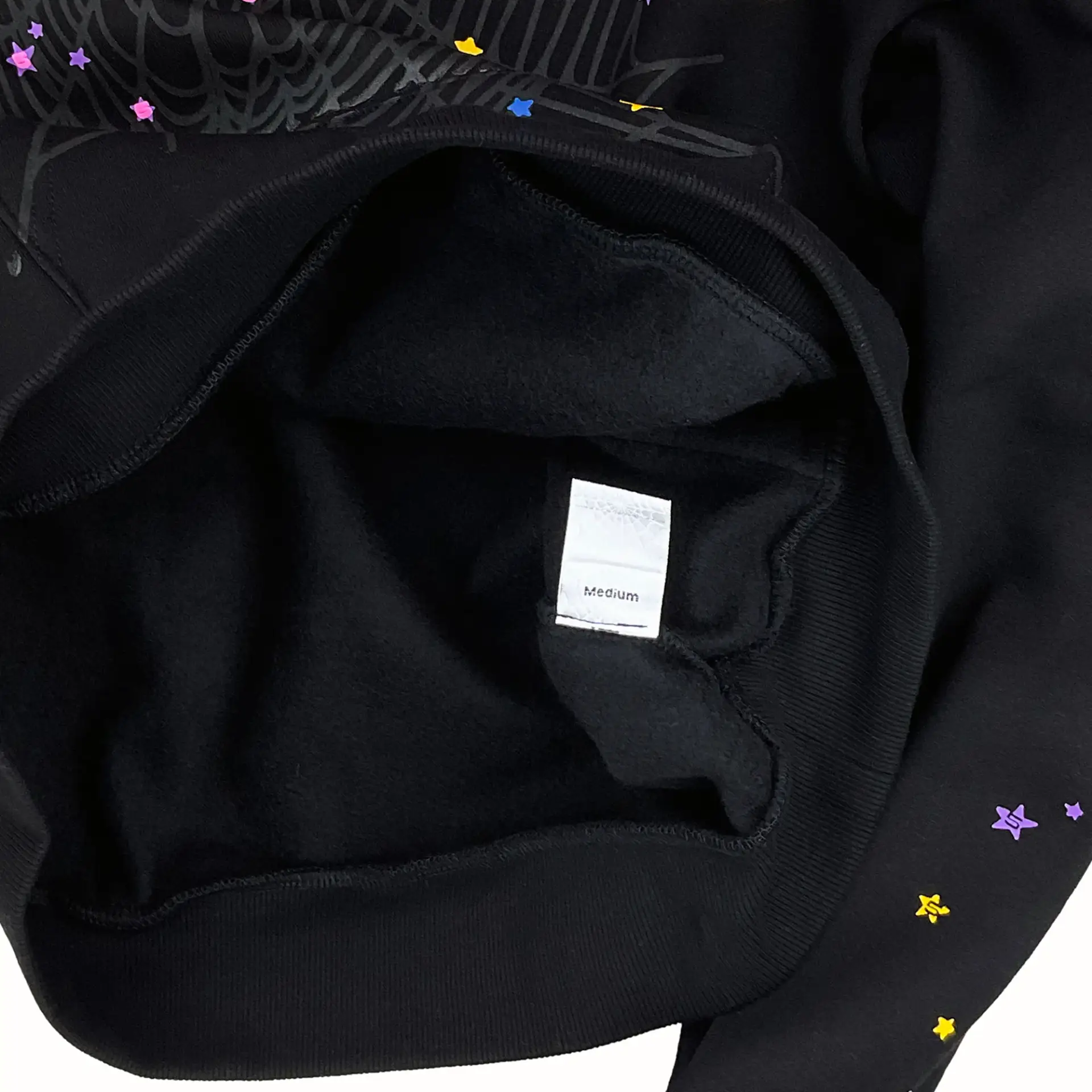
Numerous Sp5der’s most sought-after and most frequently faked hoodies feature crystal embellishments, and the quality difference between real and counterfeit crystal detailing is one of the clearest ways to verify authenticity available. On real Sp5der garments, stones are set one by one into the fabric using a process that ensures each crystal is firmly set, precisely positioned, and flush with the surrounding material. Run your fingers across the rhinestone portion of a real Sp5der hoodie and you will experience a consistent, even surface with no raised settings and no loose stones even after repeated wears and washings. Counterfeit Sp5der pieces typically use iron-on rhinestone transfers, which are applied as a single unit rather than separately embedded, and these sheets have telling visual traits: edges that lift slightly where the panel meets the material, an inflexible texture compared to individually embedded rhinestones, and prone to peeling at the edges after minimal wear. The rhinestones on imitation hoodies are frequently clearly less sparkly, of smaller dimensions, or less accurately cut than real-quality crystals, yielding less light-catching brilliance and a cheaper overall appearance. Examining the reverse side of the fabric at the embellished section is equally informative: real one-by-one setting displays tiny, regular anchor points, while iron-on transfers create a flat, even reverse side that is immediately distinguishable. Even a single loose stone on a new, unworn hoodie signals a problem, as genuine Sp5der crystal work is remarkably resilient.
Review the Inside Labels and Tags
Inside labels serves as an essential authentication checkpoint because replica producers seldom spend enough resources in reproducing the precise typography, material, and placement of genuine brand tags. Genuine Sp5der pieces features labels with sharp, crisp printing — each letter is crisp and consistent, with no blurred edges, image pixels, or inconsistent stroke thickness. The label fabric on genuine pieces has a unique hand feel and firmness that is different from the cheap woven or printed labels used on most imitation hoodies. Typography is highly important: the specific letterforms used in the Sp5der brand name have unique features that replicas routinely mess up, particularly the numeral “5” which should align with the company’s set typography perfectly. Wash care labels on real pieces are consistently positioned and use consistent symbols and instructions that match across all authentic garments. Care labels should specify a cotton-primary fabric blend consistent with the fabric’s actual heavyweight fleece construction — any tag stating a polyester-heavy blend on any item sold as real Sp5der is an instant warning sign. Imitation tags typically lack substance or have off-center stitching where they are sewn into the piece, whereas real Sp5der labels are attached with the same quality as the rest of the piece’s craftsmanship.
Authentic vs. Fake Sp5der: Key Comparison Breakdown
| Inspection Criterion | Real Sp5der | Imitation Version |
|---|---|---|
| Fabric weight | Thick, heavy-duty cotton fleece (380–420 GSM) | Lightweight, thin, frequently synthetic |
| Spider web print lines | Sharp lines, even thickness, precise crossings | Fuzzy edges, inconsistent widths, blobs at intersections |
| Rhinestone setting | Individually set, flush with fabric, secure | Iron-on panel, lifted borders, peels fast |
| Color saturation | Bold, even, consistent from edge to edge | Dull, patchy, washed-out look |
| Internal label print | Clear letters, accurate font, premium label | Blurry font, wrong letterforms, cheap label material |
| Thread work | Tight, even, consistent throughout | Slack, irregular, inconsistent stitch tension |
| Drawstring metal work | Metal eyelets, quality aglets | Hollow plastic eyelets, cheap aglets |
Assess Seams and Construction Details on the Entire Piece
Beyond the graphic and fabric, the manufacturing specifics of a Sp5der hoodie offer valuable authentication information that counterfeiters frequently neglect to save on production costs. Genuine Sp5der stitching is dense and even across the entire piece, with thread density that demonstrate exceptional manufacturing standards — when you examine the stitching closely, the thread work should be consistent in both size and spacing with no stray threads or missed stitches. Extra-strength seams at high-stress points like the cuffs, pocket opening, and hemline are a defining feature of real garments that the majority of fakes omit choosing instead simple single-thread stitching. Hardware details are a further point of differentiation: the metal holes through which the drawstring runs on an authentic piece are uniformly finished and sit flush with the fabric, while fake hardware are often plastic, imprecisely set, or vary in size. Cord end caps — the end pieces on the drawstring ends — on genuine pieces mirror the craftsmanship of the other metal hardware, while fakes typically have flimsy plastic tips that seem hollow when touched. Checking the kangaroo pocket stitching is particularly useful, as this seam stretches across an extended run that exposes whether the uniform stitch standard is maintained or deteriorates in hidden spots. According to authentication specialists at StockX, evaluating seam construction continues to be one of the most dependable authentication methods for streetwear items because it reflects overall manufacturing investment that is hard to fake convincingly.
Turning to Authentication Professionals in 2026
For shoppers who are not yet confident in their ability to verify Sp5der pieces without help, professional authentication services give an important safety net before investing substantial funds. Platforms like Legit Check App and CheckCheck provide online authentication where users submit comprehensive images of a garment and receive a verdict from professional authenticators within a few hours. These services have developed their Sp5der verification knowledge greatly throughout 2026 as demand has grown, and their precision rates for detecting imitation Sp5der pieces are impressive when customers provide thorough, clear photos covering every key inspection point outlined here. The price of a remote authentication service — usually $5–$20 — is negligible relative to the cost of a real Sp5der garment and the economic damage of receiving a counterfeit. Hands-on verification at local consignment stores that are dedicated to streetwear is an additional route, especially helpful for buyers who have already received a possibly counterfeit item and need a hands-on assessment by a trained professional. Certain shoppers also turn to community-based help — Reddit communities like r/Sp5der and r/streetwear are filled with well-versed fans who are typically willing to review authentication photos and provide opinions on legitimacy. Establishing a foundation of authentication knowledge, whether through paid tools or community involvement, is one of the most valuable steps a dedicated Sp5der enthusiast can make in 2026. Find additional auth resources and community discussions at Highsnobiety, which consistently reports on anti-counterfeit education in the streetwear world.